


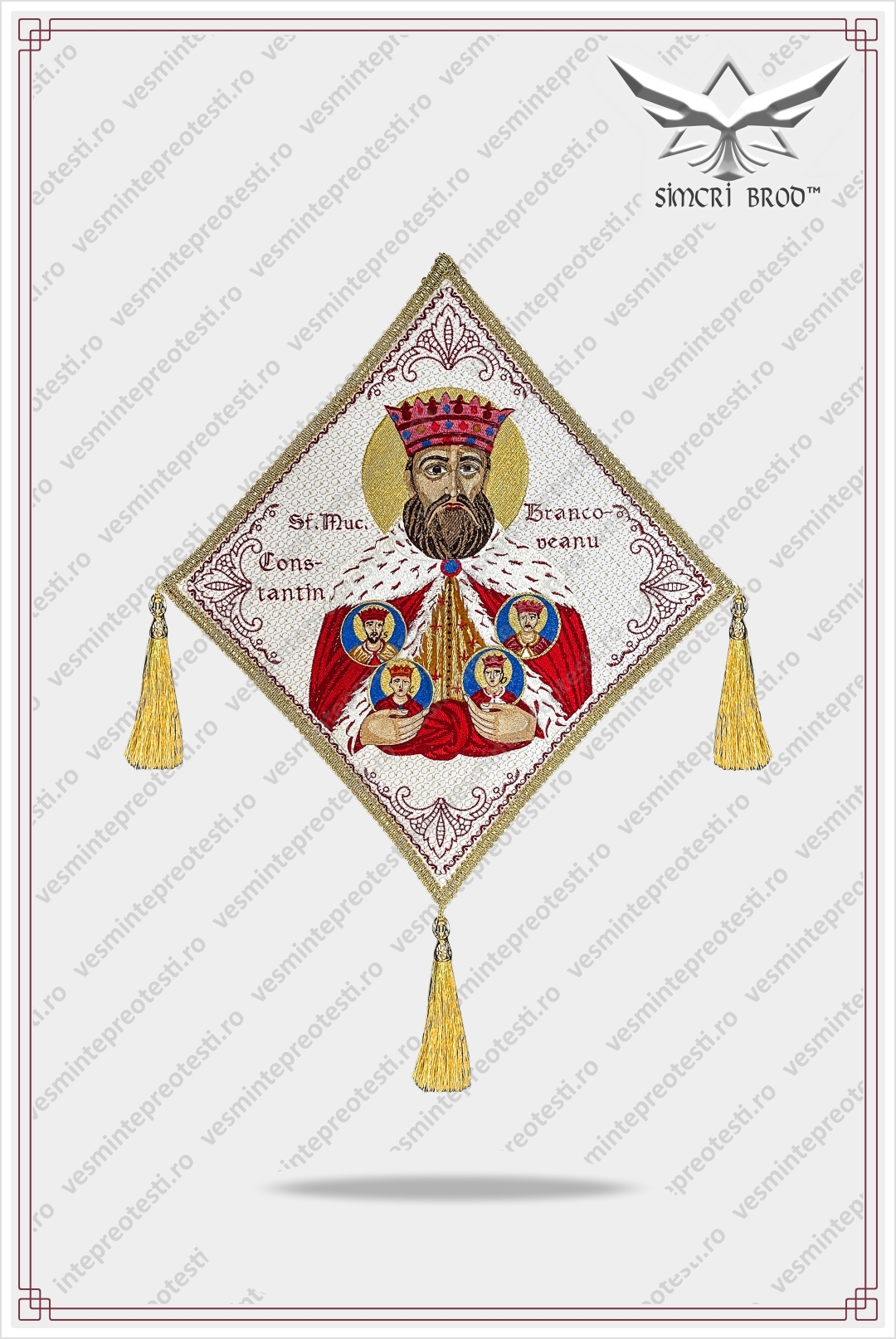


Embroidered epigonation with Saint Martyr Constantin Brâncoveanu
350,00 €
Embroidered epigonation with Saint Martyr Constantin Brâncoveanu
This pious and Christ-loving Prince of Wallachia was born in 1654 to noble parents: on his father’s side, a descendant of Prince Matei Basarab, and on his mother’s side, the grandson of Prince Șerban Cantacuzino, during whose reign, in 1688, the Holy Scripture was printed in its entirety in Romanian for the first time.
Orphaned of his father as an infant, young Constantin was raised by his uncle, Stolnic Constantin Cantacuzino, the most learned boyar of his time. He ensured that Constantin received instruction from wise teachers, providing him with a distinguished education. For his skill and wisdom, Constantin was granted high offices, enjoying great respect from an early age.
After the death of Voivode Șerban Cantacuzino on October 29, 1688, through the insistence of all the boyars and officials of the country, the worthy Constantin Brâncoveanu ascended to the throne as ruler of Wallachia, being anointed by Metropolitan Teodosie. Endowed by God with exceptional gifts, he governed the country with deep wisdom and vigilant care, exercising Christian gentleness and patience.
Taking Christ, the eternal Emperor, as his helper and following the example of his worthy predecessors, Voivode Constantin began his glorious reign by laying the foundation of the greatest monastery he founded, at Hurezi, where he also prepared his place for eternal rest. Countless are the churches and monasteries built or endowed by this merciful and devout ruler throughout Wallachia.
The generosity and care of the devout Voivode Constantin Brâncoveanu did not stop at the borders of Wallachia but extended to the Romanian brethren in Moldavia and Transylvania, as well as to the Orthodox Christians suffering in the Syrian, Caucasian, and Arab lands, and to all the holy places of the East, with many notable acts of aid.
Thus, during Holy Week in the year 1714, Sultan Ahmed III of the Turks sent a large army, seized Voivode Constantin along with his sons and sons-in-law, and, to the grief of all the inhabitants of Bucharest, took them to the Sublime Porte. There, the Christian Voivode and his eldest son were cruelly tortured by the unbelievers for four months, enduring immense suffering.
After nearly 25 years of glorious reign, by God’s providence, Voivode Constantin Brâncoveanu, together with his four sons—Constantin, Ștefan, Radu, and Matei—and his adviser Ianache, was granted to crown their foreheads with the holy crown of martyrdom for the Orthodox faith, which they confessed and never abandoned, even before the pagan executioner.
On the Feast of the Dormition of the Mother of God, August 15, when the Righteous Voivode Constantin Brâncoveanu turned 60, he received the martyr’s death by the sword along with his sons—Constantin, Ștefan, Radu, and Matei—and his advisor Ianache, in the city of Saint Constantine the Great, Constantinople, in the year 1714. Their martyred bodies were then cast into the sea by the unbelievers, but were recovered by pious Christians and reverently buried in secret near Constantinople, on the island of Halki, in the church of the Monastery of the Mother of God.
The relics of the Holy Martyr Voivode were brought back to the country in 1720 by Lady Marica, his wife, and were buried in the Church of Saint George the New in Bucharest, his foundation. Since then and to this day, the light of the vigil lamp continues to shine, marking the resting place of the Voivode.
Through their holy prayers, O Lord, have mercy on us and save us. Amen.
source: calendar-ortodox.ro


Reviews
There are no reviews yet.